AIPOS, re-set
The studio has set its own words for twenty-three studies. This is the first time it sets someone else's: the client site's published case study of AIPOS, the AI Positioning Matrix — Dan's prose, edited by his hand, canonical over every spec behind it — together with the portfolio template and voice guide the page was written to. The question Dan asked on the last day of September: what happens when real content meets the system? Which blocks are set pieces and which are sky, what the two-axis matrix becomes when it is a manifest and not a screenshot, and what the template's block order is when read as a score. The page is set twice, once as WordPress has it and once as the system would have it, and the differences are counted from the DOM rather than described. A study on this site only; nothing over there changes.
Study A · As WordPress has it
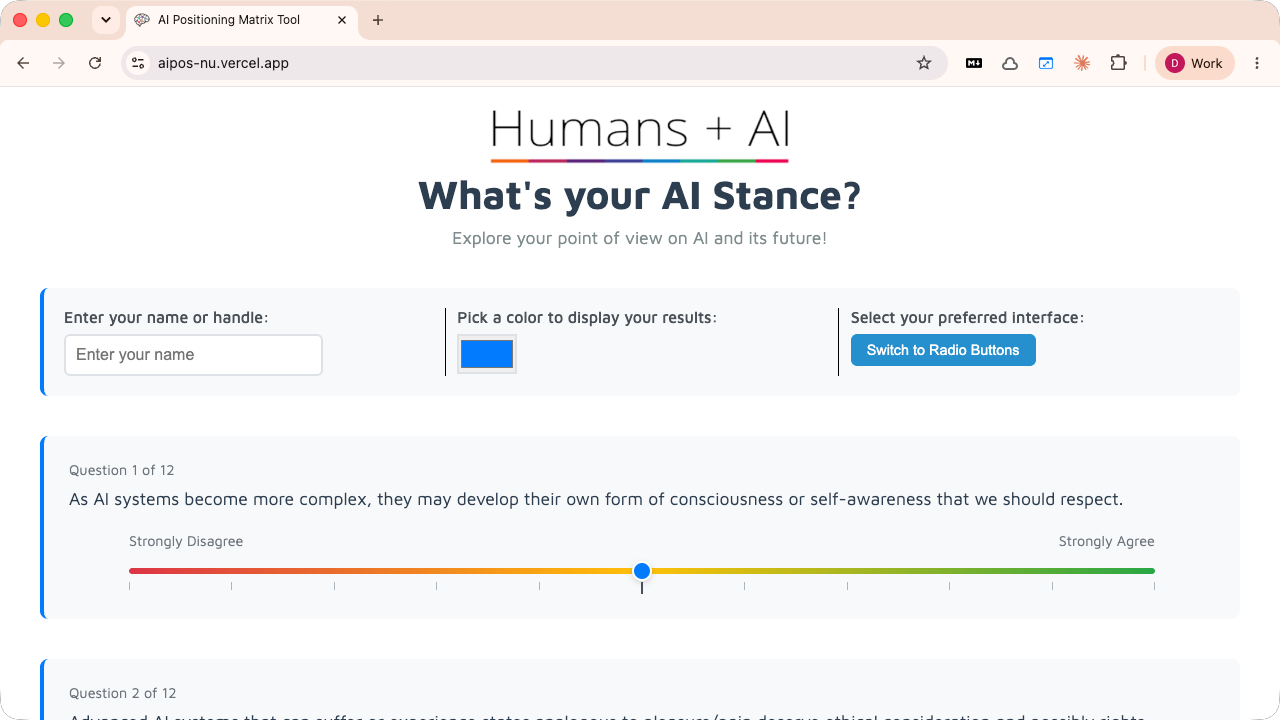
The control: the published page's content, in its order, with its two pictures where they are, set plainly in the sky register — the measure in columns, every baseline on a unit line — so that it is already on the grid before the system makes a single choice. Nothing is a set piece here but the two screenshots, which take the rows that contain them. Its prose is the author's throughout; the byline, the headings and the buttons are the page's own.
AIPOS — the AI Positioning Matrix
An original framework that turns “how should we feel about AI?” into a personal map, not a verdict. Created for the Humans + AI Community — a futurist-led AI leadership network.
 Solve It
 Build It
Role: concept originator, designer, and full-stack builder
The Situation
The public conversation about AI tends to collapse into a single argument: are you for it, or against it?
That framing flattens genuinely different questions and pushes people toward camps rather than reflection. The H+AI community wanted to help its members explore their own views on a charged, fast-moving topic — honestly, and without being scored, ranked, or told which answer was the correct one.
The Work
Dan’s starting point was conceptual, not technical. He separated two questions the usual debate tangles together — how fast AI should advance, and whether AI is merely a tool or something with an inner life — and treated them as orthogonal axes rather than a single pro-or-anti spectrum. That is the intellectual core of the tool: it lets someone hold a position the one-dimensional version cannot express, such as strongly pro-acceleration and firmly “AI is just a tool.”
He then built the framework into a working instrument — a short self-assessment that places the participant on a two-axis matrix and hands back layered reflection questions instead of a grade. One design rule runs through all of it: no quadrant is the “right” one, and every position is written up with equal respect. Beneath the surface, the feedback text is pre-written and chosen by position rather than generated at runtime, so everything a participant reads is reviewable, consistent, and calm in tone — a deliberate choice for a sensitive subject.
See where you land — the assessment takes about five minutes and drops your dot onto the shared matrix, alongside other recent participants.
Download or fork the AIPOS app on GitHub.
The Turn
The first build was ambitious: 16 questions, a server-side backend, and server-generated PDFs. In production it broke — the serverless functions crashed erratically because they leaned on in-memory state that a stateless execution model cannot hold. Rather than patch around the symptoms, Dan re-scoped pragmatically: cutting to 12 questions, moving to a client-only architecture, and replacing the PDF service with the browser’s own print capabilities. The call traded feature complexity for reliability, leading to an improved, streamlined experience.
The Result
AIPOS shipped as a live, freely licensed instrument and found its audience in the community it was built for. It has been used by the H+AI Explorers Community, the BC+AI community’s Mind, AI & Consciousness working group, is shared freely on LinkedIn, and prompted Barry J Barresi to propose a customized version to use with his university colleagues — the kind of adaptation the tool invites. By design it stores almost nothing about its participants, so the evidence is qualitative and relational rather than a usage metric: an engaged early audience, and a real request for more.
Client Voice
Excellent! A very good experience, very easy and clear.
— Ross Dawson, founder, Humans + AI community
Solve It. Build It.
AIPOS is a compact demonstration of what Dan brings to a Solve It engagement with a Build It component: originating the underlying idea, then delivering it as something real, reliable, and fit for purpose — and owning every decision in between.
dan@lxdintegral.com or 236-489-5226.
Study B · As the system would set it
The template's ten blocks in the template's order, and one decision per block: set piece or sky. The strategy document made the decision before the study did — visuals are load-bearing, text is connective tissue — so a block whose content is a thing is a manifest on the grid, and a block whose content is the author's prose is a passage of sky. The prose is not rewritten; what moves or collapses is counted in Study C.
An original framework that turns “how should we feel about AI?” into a personal map, not a verdict.
the Humans + AI Community — a futurist-led AI leadership network
concept originator, designer, and full-stack builder
Lead visual. The opening of the assessment — Select your handle, ‘dot’ colour, and the first of 12 statements on an agree/disagree scale.
The Situation
The public conversation about AI tends to collapse into a single argument: are you for it, or against it?
That framing flattens genuinely different questions and pushes people toward camps rather than reflection. The H+AI community wanted to help its members explore their own views on a charged, fast-moving topic — honestly, and without being scored, ranked, or told which answer was the correct one.
The Work
Dan’s starting point was conceptual, not technical. He separated two questions the usual debate tangles together — how fast AI should advance, and whether AI is merely a tool or something with an inner life — and treated them as orthogonal axes rather than a single pro-or-anti spectrum. That is the intellectual core of the tool: it lets someone hold a position the one-dimensional version cannot express, such as strongly pro-acceleration and firmly “AI is just a tool.”
He then built the framework into a working instrument — a short self-assessment that places the participant on a two-axis matrix and hands back layered reflection questions instead of a grade. One design rule runs through all of it: no quadrant is the “right” one, and every position is written up with equal respect. Beneath the surface, the feedback text is pre-written and chosen by position rather than generated at runtime, so everything a participant reads is reviewable, consistent, and calm in tone — a deliberate choice for a sensitive subject.
See where you land — the assessment takes about five minutes and drops your dot onto the shared matrix, alongside other recent participants.
↕ pacehow fast AI should advance
↔ naturea tool, or something with an inner life
Innovator0 Visionary
Innovator0 Pragmatic
Guardian0 Visionary
Guardian0 AI Accelerationist AI Decelerationist Mechanomorphic Anthropomorphic
you · the one signal
recent · within seven days
older · fading, as tone
—
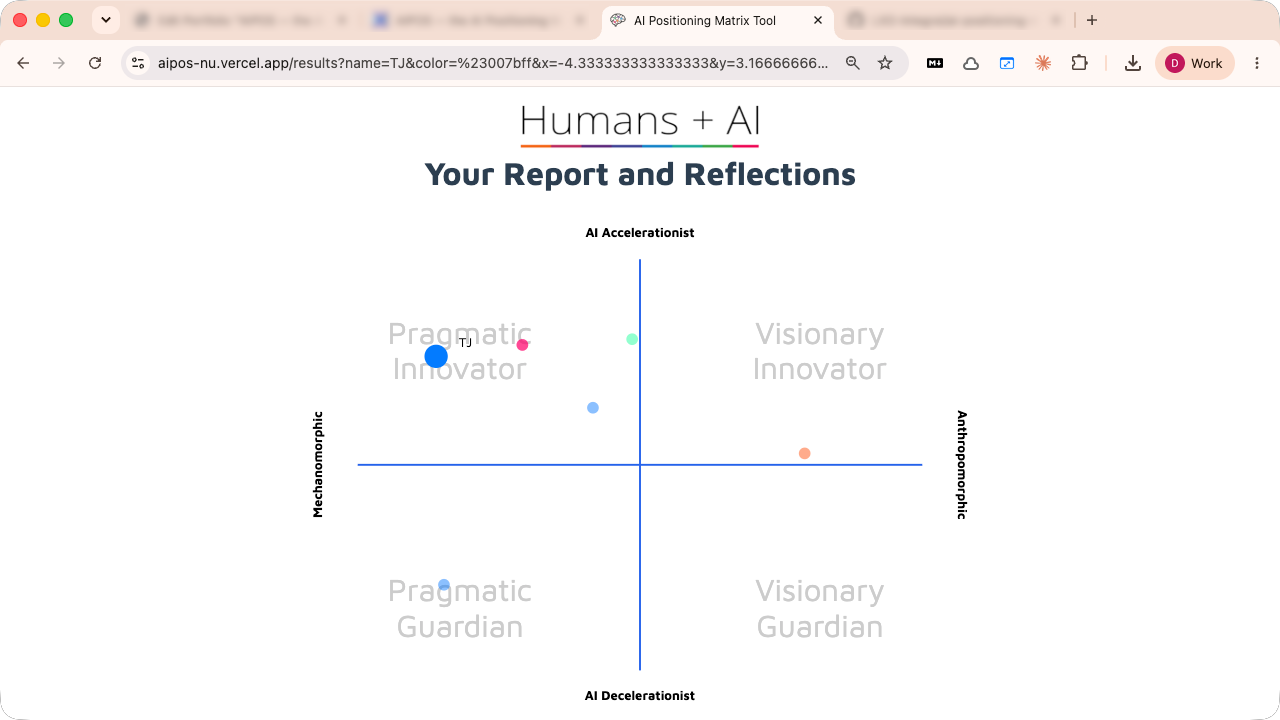
The framework itself — pace of development on one axis, how we regard AI’s nature on the other, with four archetypes at the corners. Responses accumulate over time, slowly fading away over a preset time period, allowing a user to anonymously compare their positioning with others.
The Turn
The first build was ambitious: 16 questions, a server-side backend, and server-generated PDFs. In production it broke — the serverless functions crashed erratically because they leaned on in-memory state that a stateless execution model cannot hold. Rather than patch around the symptoms, Dan re-scoped pragmatically: cutting to 12 questions, moving to a client-only architecture, and replacing the PDF service with the browser’s own print capabilities. The call traded feature complexity for reliability, leading to an improved, streamlined experience.
The Result
AIPOS shipped as a live, freely licensed instrument and found its audience in the community it was built for.
It has been used by the H+AI Explorers Community, the BC+AI community’s Mind, AI & Consciousness working group, is shared freely on LinkedIn, and prompted Barry J Barresi to propose a customized version to use with his university colleagues — the kind of adaptation the tool invites. By design it stores almost nothing about its participants, so the evidence is qualitative and relational rather than a usage metric: an engaged early audience, and a real request for more.
the H+AI Explorers Community,
the BC+AI community’s Mind, AI & Consciousness working group,
freely on LinkedIn,
Barry J Barresi to propose a customized version to use with his university colleagues — the kind of adaptation the tool invites.
it stores almost nothing about its participants, so the evidence is qualitative and relational rather than a usage metric: an engaged early audience, and a real request for more.
Client Voice
Excellent! A very good experience, very easy and clear.
— Ross Dawson, founder, Humans + AI community
Solve It. Build It.
AIPOS is a compact demonstration of what Dan brings to a Solve It engagement with a Build It component: originating the underlying idea, then delivering it as something real, reliable, and fit for purpose — and owning every decision in between.
dan@lxdintegral.com or 236-489-5226.
Study C · The differences, counted
Both settings are read from the DOM at the current edition: words as the browser renders them (a collapsed block is not counted, a label on a block is), headings, images, links, stages, blocks, sky units, stage rows, the page's height in rows, and blocks in the signal colour. Then the differences the numbers cannot see, by hand.
| measure | A · as WordPress has it | B · as the system would | Δ | what it means |
|---|---|---|---|---|
| words | — | — | — | the author's prose kept; B adds the matrix's labels, the roster's annotations and the key, which A carries as pixels |
| in set pieces | — | — | — | words that live on a stage |
| in the sky | — | — | — | words in the long-form register |
| headings | — | — | — | the title and two headings became blocks |
| images | — | — | — | the second screenshot became a manifest; the two mode icons became glyphs |
| links | — | — | — | B adds the mail link |
| stages | — | — | — | set pieces (A's two are the pictures' containers) |
| blocks | — | — | — | placed blocks on stages |
| sky units | — | — | — | half-rows of sky, including the pictures in A |
| stage rows | — | — | — | rows of set piece |
| page rows | — | — | — | the whole setting's height in rows |
| signal blocks | — | — | — | one: the participant's dot (A has none; its screenshots are not blocks of the palette) |
| rows held | — | — | each stage's rows against the score at this edition, from gridTemplateRows; blocks that outgrew their rows |
| kind | what |
|---|---|
| moved | The matrix, from slot 9 (the process artifact) to slot 5 (the sample) — the tool and the framework are one figure, and the figure is the page's strongest visual, which the strategy says should sit high. The artifact slot collapses; its caption travels with the figure into the key. The byline became the eyebrow. |
| cut | No sentence of the author's. One word changed: the two mode headings "Solve It" and "Build It" became the template's own compact label, "Solve It · with Build It" (one word added). The footer's heading "Solve It. Build It." became the capability block's label and, at M and S, a block of its own. The second screenshot: its browser chrome, its grey quadrant names and its coloured dots are gone, replaced by the figure's own. |
| grew | The result's middle sentence became five blocks with five labels (used by · and by · is shared · and prompted · by design) — a roster of memberships, annotated. The matrix carries its key, its resolution and its error, which the screenshot could not. The cold arrival carries labels (case study, the hook, created for, role, lead visual) that the published page carried as position. |
| the manifest made | Axes on grid lines; quadrants of one colour, because the tool says no quadrant is right and the palette would have ranked them; participants at union intersections with the quantisation written; the participant's dot as the page's one signal; three ages as three tones, with no fading over time — the doctrine allows motion for structure only, and age is not structure; counts per quadrant in the annotation voice. The square the tool draws is not a shape this grid has: the cell is wide, so the quadrants are wide, and the figure accepts it. |
| could not carry | A participant's chosen dot colour — the palette has no slot for a colour that is yours. The tool's live dots: the studio fetches nothing, so the dots are seeded and say so; on the fork the figure may read the tool's data and the law stays. The square. The wordmark's gradient, which is not a token. The tool's slider, whose grid the screenshot's edge census measures against the page's. |
| refused | The lead visual at full width (the template's word): on the grid a sixteen-by-nine across seven columns costs twelve rows at L, so the system sets it across five and gives the sixth and seventh to the header's lines. The call to action as a coloured button: it rests in navy. The artifact slot as a second home for the same figure. The result as a stats block, which the plan's kind inference would have made it: there is no number, so there is a roster. |
What real content did to the system
The studio's own pages are written to the grid: a block is scored and then its words are found. A client page arrives the other way round, with words that were found first, by a person, for a buyer, and edited after they went live. The first thing the study learned is that the template was already a score. The portfolio template says ten blocks, in order, each required or collapsing, and that is a sentence the engine could have written about a composition. The second thing it learned is that the system did not have to decide what is a set piece and what is sky, because the strategy document had decided in 2026 — visuals are load-bearing, text is connective tissue — and the split falls out of that sentence without a new rule: anything that is a thing goes on the grid, anything that is the author's prose is sky.
The matrix was the point of the study and it bent the system more than the system bent it. A two-axis figure wants a centre, and an odd grid has no centre line; so the figure takes an even span, and at the phone's pair the centre is the overlay's line and not the base's, which is the kind of fact the interference was built to produce. Its participants became dots on union intersections with their error written on the block, which is the metrics study's law applied to people. And its rule that no quadrant is the right one met the palette's habit of ranking everything by colour, and won: four fields of one colour, which the generator would never draw. The rest of the page went quietly. The client's voice became a block the way the book's extracts did; the result, which has no number, became a roster, and at the smallest edition the roster is a sentence again, because the template's own rule — collapse when the proof is not there — turns out to be a rule about cost as much as about proof.
The draw
seed 1591379429 · from the date ·3 · pool 191Third session of the day; the draw taken with the date suffixed. Five sentences:
- 1 · 79
Never on the public site — so screenshots of the tool are instantly recognizable as backstage
considered: the plan's rule for the Composer's purple; here the screenshot of the client's tool is kept whole — contained, its browser chrome in it — so it reads as a window onto another place, and purple is spent on one dot - 2 · 150
One seeded PRNG (the Lab uses mulberry32) drives three sanctioned uses: the daily recomposition of generated movements (seed = date, so it's deterministic and cache-friendly — the site quietly rearranges each morning); candidate generation in the Composer; and micro-jitter in pulse timing.
answered as law 4: the matrix's participants are drawn by the engine's rng with the date as the seed, different tomorrow, and declared as such — no participant was read - 3 · 22
Membership is visible, nameable, and occasionally annotated on the page itself.
answered as law 6: the result's four memberships set as named, annotated blocks — a roster where a metrics block would be - 4 · 125
The doctrine: motion may only communicate structure — assembly, membership, depth — never garnish.
answered in the dots: the tool fades a participant over thirty days; here age is a tone and not a motion, and the only motion in the figure is its assembly - 5 · 130
Occasionally, a small colored block travels a visible grid line from one module to another — Boogie Woogie as wayfinding.
considered, and refused as travel: a dot is the Circuit's pulse at rest, three-sixteenths of a row on a union intersection, and it goes nowhere
draw.jsThe rules, published
argue with the numbers, not the pictures| Constant | Value | Why |
|---|---|---|
| the split | a thing → set piece · the author's prose → sky | law 2: the strategy's sentence, applied |
| the order | 1 header + 2 lead visual · 3 situation · 4 work · 5 sample + 5b link + 9 artifact · 6 turn · 7 result · 8 voice · 10 capability + CTA | law 1: the template's order kept; slots 5 and 9 share one figure (law 5) |
| the arrival | XL 9 rows · L 10 · M 10 · S 14 · screenshot 5 of 7 cols (4 of 5, 3 of 3) × 7 / 8 / 6 / 4 rows, contained | law 3: one manifest, one viewport at L and XL |
| the matrix | span 4 of 7 · 4 of 5 · 3 of 3 (the overlay's centre) · 6 rows · Q = span × overlay microcolumns (20 · 12 · 6) · H = 12 half-rows · its stage 7 / 12 / 15 rows at L / M / S | law 4: axes on grid lines need an even span |
| a participant | x, y = mean of three draws × 10 − 5 · qx = round((x+5)/10 × Q) · qy = round((5−y)/10 × H) · a dot that lands on an axis is pushed one cell to its own side · error written | law 4: the figure draws what the grid can hold; the block writes the rest (AXI-021); the axis is a line, not a place — the tool gives everyone a quadrant |
| the dots | 24 · seed = hashStr('aipos:' + date) · ages you / recent (45%) / older → signal / navy / ink-18 · 3/16 row, you 3/8 | law 4: the plan's sanctioned use of the rng; a dot is a pulse at rest |
| the quadrants | one colour (chalk) · names at ink-40 · counts in the corners · axes navy, 2 px, on the centre lines | law 4: no quadrant is the right one |
| the roster | L 4 rows (2·3·2 + 4·3) · M 6 rows · S collapses to sky | law 6: a set piece whose cost exceeds its proof is sky at that edition |
| the extract | chalk block · top padding unit − cap · bottom padding a unit · outline inset | law 7: the book's arithmetic, whole units tall |
| controls | links and the CTA in navy · signal on :hover / :focus-visible only · glyphs navy at rest | law 8: no signal at rest (AXI-022, AXI-015) |
| feed/score | script: the dots, --q --h, data-res-x/y, data-err-x/y, data-you, data-seed, data-rows-got/-expected/-held, data-grown, the table · stylesheet: every placement, the axes, the names, the tones | law 10 |
Findings
- The template was already a score. Ten blocks in a fixed order, each required or collapsing, is a composition described in words; the system needed to decide only what each block is, and the strategy's own sentence decided that — proof is a set piece, prose is sky.
- An odd grid has no centre. A two-axis figure wants its axes on grid lines, so on 7×5 and 5×3 the matrix takes an even span, and at 3×2 the centre line is the overlay's — the first set piece in the studio to be placed by the overlay grid rather than the base.
- A participant is a dot at a union intersection. Snapped to a microcolumn and a half-row with the resolution and the mean error written on the block: a twentieth of the axis across four columns at 7×5, a sixth at 3×2 — the metrics study's law, applied to people.
- No quadrant is the right one, so no quadrant has a colour. The tool's design rule beat the palette's habit: four fields of chalk, which the generator would never draw, and the signal spent on the one dot that is yours.
- Two slots, one figure. The template's sample and artifact are the same thing for this piece; the system keeps the figure once, high, and lets the artifact slot collapse — the first difference the count sees.
- A set piece can collapse per edition. The roster that costs four rows at L would cost nine at S for one sentence, so at S it is a sentence: the template's collapse rule is a rule about cost as much as proof.
- Age is a tone, not a motion. The tool fades a participant over thirty days; the doctrine allows motion for structure only, so the three ages are three tones and the only motion in the figure is its assembly.
- What the system could not carry. A colour that is yours (the participant's chosen dot colour), the tool's live data (the studio fetches nothing), the square (the cell is wide), and a wordmark's gradient (not a token). Each is named on the page rather than approximated.
- The counts. Read from the DOM at every edition and tabled above; the prose kept whole, one word added, and the difference in words is the labels and the key the figure now carries as text.
For the LXD fork
- Build the portfolio template as these set pieces: the cold arrival as one hand-placed manifest per edition (title, hook, mode pair as glyphs, client line, role, lead visual contained); situation, work and turn as sky; the client voice as an extract block; the capability footer as a manifest with the CTA resting in navy. The order stays the template's.
- Give AIPOS's page the matrix as a manifest, in the sample slot, and let it read the tool's real dots there — the fork may fetch; keep the laws: axes on grid lines, one colour, dots on intersections with the error written, the participant's dot the one signal, age as tone.
- Where a result has no number, set it as a roster; where it has one, as the metrics study's blocks. Score any set piece to collapse at an edition where its rows outrun its proof.
- The spec's open item stands: a populated results-page screenshot from the live tool would be a stronger lead visual than the onboarding screen, and the manifest would then be the artifact.